

Table of Contents: tyre pressure australia
Tyre pressure is the single most influential variable in tyre performance, safety, and longevity — yet it remains one of the most consistently neglected aspects of vehicle maintenance globally. In the extreme climates of Australia and the Middle East, where ambient temperatures swing dramatically between seasons and between desert and coastal environments, pressure management demands a technical and disciplined approach.
The Physics of Tyre Pressure and Temperature
Tyre pressure obeys Gay-Lussac’s Law: at constant volume, pressure is directly proportional to temperature. In practical terms, for every 10 degrees Celsius change in ambient temperature, tyre pressure changes by approximately 7 kPa (1 PSI). This has direct implications for drivers in both target markets:
In Australia, night temperatures in the outback can drop to 5 degrees Celsius, while daytime road surface temperatures can exceed 60 degrees Celsius — a potential pressure differential of 38 kPa (5.5 PSI) across a single day
In Saudi Arabia and Kuwait, seasonal variation between winter (15 degrees Celsius) and peak summer (50 degrees Celsius) creates a differential of approximately 25 kPa (3.6 PSI) between cold and operating pressures
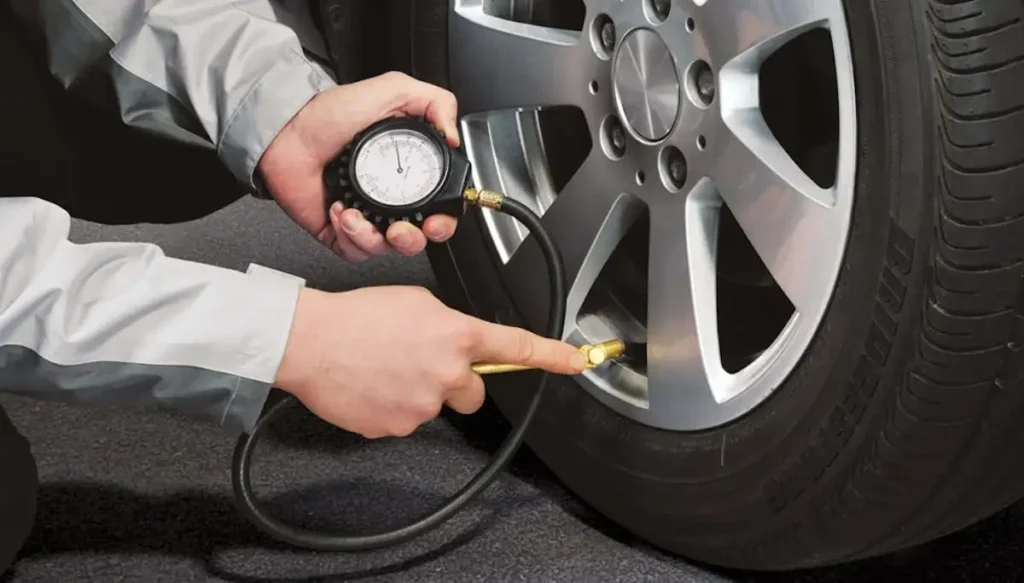
Always measure tyre pressure when tyres are cold — meaning the vehicle has been stationary for a minimum of three hours, or driven fewer than 3 km at low speed. Hot pressure readings are unreliable as a baseline and should never be deflated to match cold pressure specifications.

Tyre Deflation for Off-Road Driving
Reducing tyre pressure for off-road driving is a fundamental technique for improving traction on sand, mud, and rocky terrain. The mechanics are straightforward: lower pressure increases the tyre’s footprint by allowing the sidewall to flex outward, distributing vehicle weight over a larger contact patch.
Recommended Pressures by Terrain Type
Sealed highway: OEM specified pressure (typically 220–280 kPa for SUVs)
Gravel and corrugated dirt roads: Reduce by 20–30 kPa
Rocky terrain (Australian outback tracks): Reduce to 160–180 kPa
Sand driving (Middle East dunes, Australian coastal dunes): Reduce to 100–140 kPa
Soft bog/mud: Reduce to 80–120 kPa (with bead lock wheels recommended)
Critical warning: Never drive at highway speeds with deflated tyres. At 100 km/h with tyres at 140 kPa, heat builds rapidly in the tyre structure, dramatically increasing blowout risk. Always reinflate before returning to sealed roads using a quality on-board compressor or CO2 inflation system.
Tyre Pressure Monitoring Systems (TPMS)
Tyre Pressure Monitoring Systems are mandatory on all new passenger vehicles sold in the European Union and United States. While not yet universally mandated in Australia or Gulf Cooperation Council (GCC) countries, they are increasingly standard on new SUVs and are highly recommended as an aftermarket addition.
There are two TPMS technologies in common use:
Direct TPMS
Pressure sensors are mounted inside each wheel and transmit real-time pressure data to a dashboard display. Accuracy is typically within 3 kPa. Battery life is 5–10 years. Sensors must be replaced when fitting new tyres if externally mounted.
Indirect TPMS
Uses wheel speed sensors from the Anti-lock Braking System (ABS) to detect pressure loss by monitoring rotational speed differentials between wheels. A deflated tyre has a smaller effective rolling radius and rotates faster than a properly inflated tyre. Less accurate than direct systems but requires no additional hardware.
For 4WD drivers in Australia and the Middle East who regularly air down for off-road use, aftermarket direct TPMS systems with remote displays — such as those offered by TyreDog or PressurePro — provide real-time monitoring across all five tyres including the spare.
Nitrogen vs Air for Tyre Inflation: tyre pressure australia
Nitrogen inflation is offered by many tyre retailers in Australia and the UAE as a premium service. The claimed benefits are based on nitrogen’s lower moisture content compared to compressed air — moisture contributes to pressure fluctuation with temperature change.
The technical reality: dry compressed air (as produced by quality on-board compressors or professional workshop equipment) performs comparably to nitrogen. The marginal benefit of nitrogen is measurable in laboratory conditions but largely imperceptible in real-world driving. The primary practical advantage of nitrogen is colour-coded valve caps that help identify nitrogen-filled tyres — preventing inadvertent top-up with compressed air, which reduces the nitrogen concentration.
For most drivers in both markets, maintaining correct pressure with standard compressed air and a quality pressure gauge will deliver equivalent performance outcomes to nitrogen at zero additional cost.
Check out some of out tyres for tyre pressure australia
- Uncategorized12 products
- Aircraft Tires4 products
- Continental33 products
- Dunlop2 products
- Firestone22 products
- Tire Brands127 products
- Bridgestone35 products
- Double Coin27 products
- Michelin21 products
- Triangle19 products
- Yokohama25 products